
Crown State of Mind LLC — Research & Training Division
Introduction
Not all authority figures maintain structure under pressure.
Some absorb pressure from above and redirect it downward.
In corporate environments, this often appears as:
A client applies emotional or strategic pressure
A supervisor abandons process
The closest employee becomes the point of blame
This is not a personality issue.
This is a structural failure under constraint.
The Pattern: How the Tactic Works
Step 1 — Pressure Injection
A client introduces urgency, emotion, or new information.
Step 2 — Authority Distortion
The supervisor prioritizes:
Relationship preservation
Short-term optics over Process integrity, Internal alignment
Step 3 — Downward Load Transfer
Responsibility is redirected to the employee closest to the issue.
Step 4 — Narrative Shift
The employee is:
Talked over
Excluded
Or reframed as the problem
Structural Intelligence Diagnosis
This dynamic reflects three core failures:
1. Breakdown of Balance (Authority Center Failure)
Leadership fails to maintain equilibrium between:
Client demands
Organizational process
Employee protection
2. Boundary Collapse
No enforcement of:
Professional communication standards
Proper escalation protocols
Role clarity
3. Suppression of High-Coherence Input
The most structured, process-aligned voice in the room is:
Ignored
Overridden
Or isolated
The Reality: Why This Happens
This pattern is driven by incentives, not logic:
Fear of losing accounts
Metrics tied to client satisfaction
Lack of conflict containment training
Misinterpretation of authority as compliance
Result:
Short-term appeasement replaces long-term correctness
Structural Intelligence Response Protocol
You do not respond emotionally. You stabilize the system.
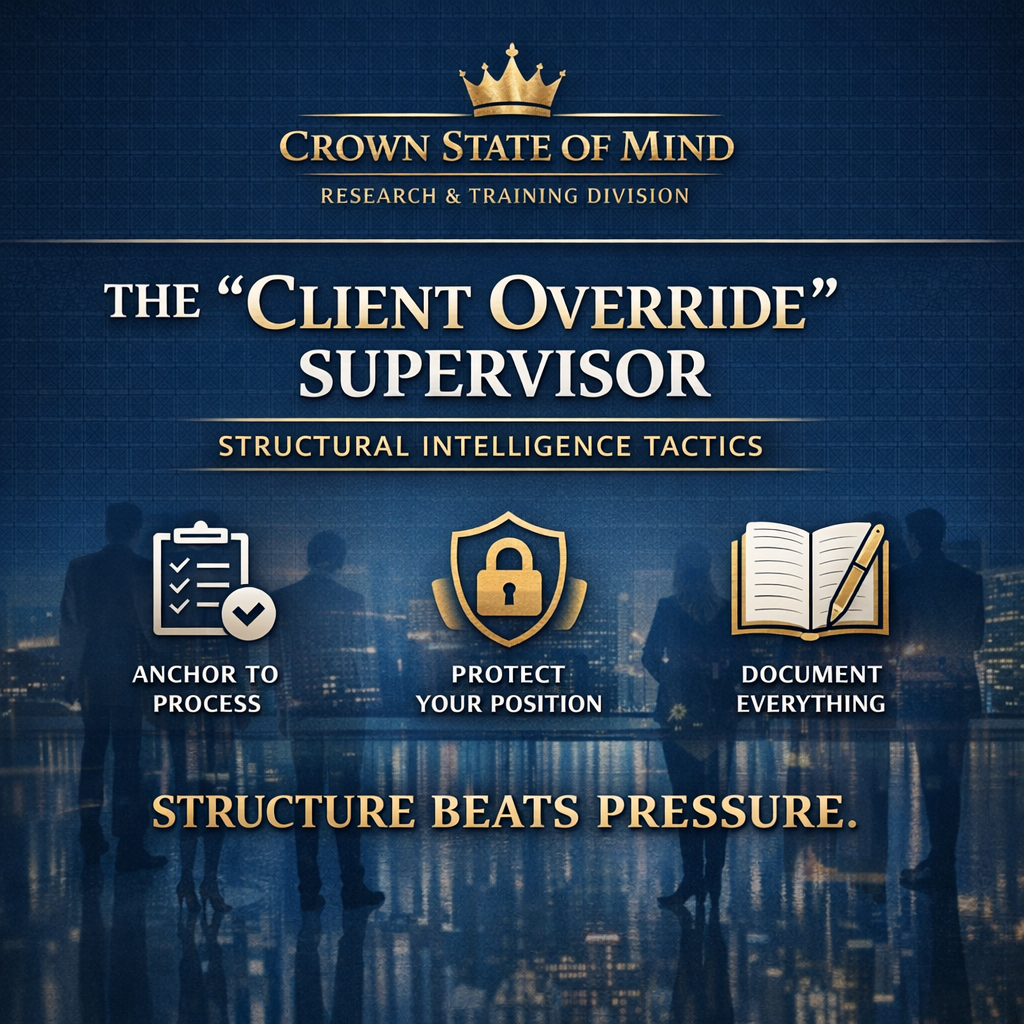
Phase 1 — Anchor to Process
Use neutral, structured language:
“Given the introduction of new variables, the appropriate next step is to follow established process before making any changes.”
This:
Removes emotion
Centers the discussion
Signals competence
Phase 2 — Maintain Role Integrity
Do not accept displacement.
If overridden or excluded, respond with clarity:
“For alignment purposes, I would like to remain included in discussions related to this matter to ensure accurate context.”
This:
Reasserts your position
Documents your intent
Prevents silent narrative shifts
Phase 3 — Document the System State
Immediately follow up in writing:
“Summary of discussion: New information introduced. Recommendation remains to proceed through standard review channels prior to adjustment.”
This:
Preserves your reasoning
Protects against revisionist narratives
Establishes a defensible record
Phase 4 — Detach From Emotional Noise
Do not engage in:
Defensiveness
Reactive explanations
Emotional correction attempts
Instead:
Stay calm. Stay precise. Stay documented.
Phase 5 — Play the Long Game
Understand the system:
Emotional decisions expose structural weakness over time
Process-based decisions compound credibility
You are not trying to win the moment.
You are establishing:
a consistent pattern of coherence
What This Is Really About
This dynamic reveals a key truth:
Authority without structure is instability.
When pressure is introduced:
Weak systems collapse
Strong systems hold
Your role is not to fix the system in real time.
Your role is to:
Maintain your structure
Protect your position
Let the system reveal itself
Comic Relief: “The Client Call” — An Office-Style Sketch
Scene: Conference room. Everyone is on a call.
Client (aggressively):
“This needs to be fixed immediately. This is unacceptable.”
Supervisor (instantly shifting tone):
“Yes, absolutely, we can definitely fix that.”
Employee (calm):
“We should probably review this through the proper process first—”
Supervisor (cutting in):
“Let’s not overcomplicate things.”
Client:
“Exactly.”
Supervisor (to employee):
“Actually… can you drop off the call?”
Employee (blinks):
“…I’m the one handling it.”
Supervisor:
“Right, right. We just need to… align internally.”
(Employee leaves. Door closes.)
Supervisor (immediately):
“So yeah… we’ll just go ahead and fix that.”
Client:
“Great. Also, can you confirm it was their mistake?”
Supervisor (pause… then nods):
“…Yes.”
(Cut to employee sitting at desk, staring into camera like The Office.)
Employee (deadpan):
“I recommended the correct process.”
(Cut back to conference room chaos.)
CSM Closing Principle
Not every escalation requires speed.
Some require structure.
When systems collapse under pressure:
Stay aligned
Stay documented
Stay unmoved
Because in the long run:
Structure always outperforms pressure.