
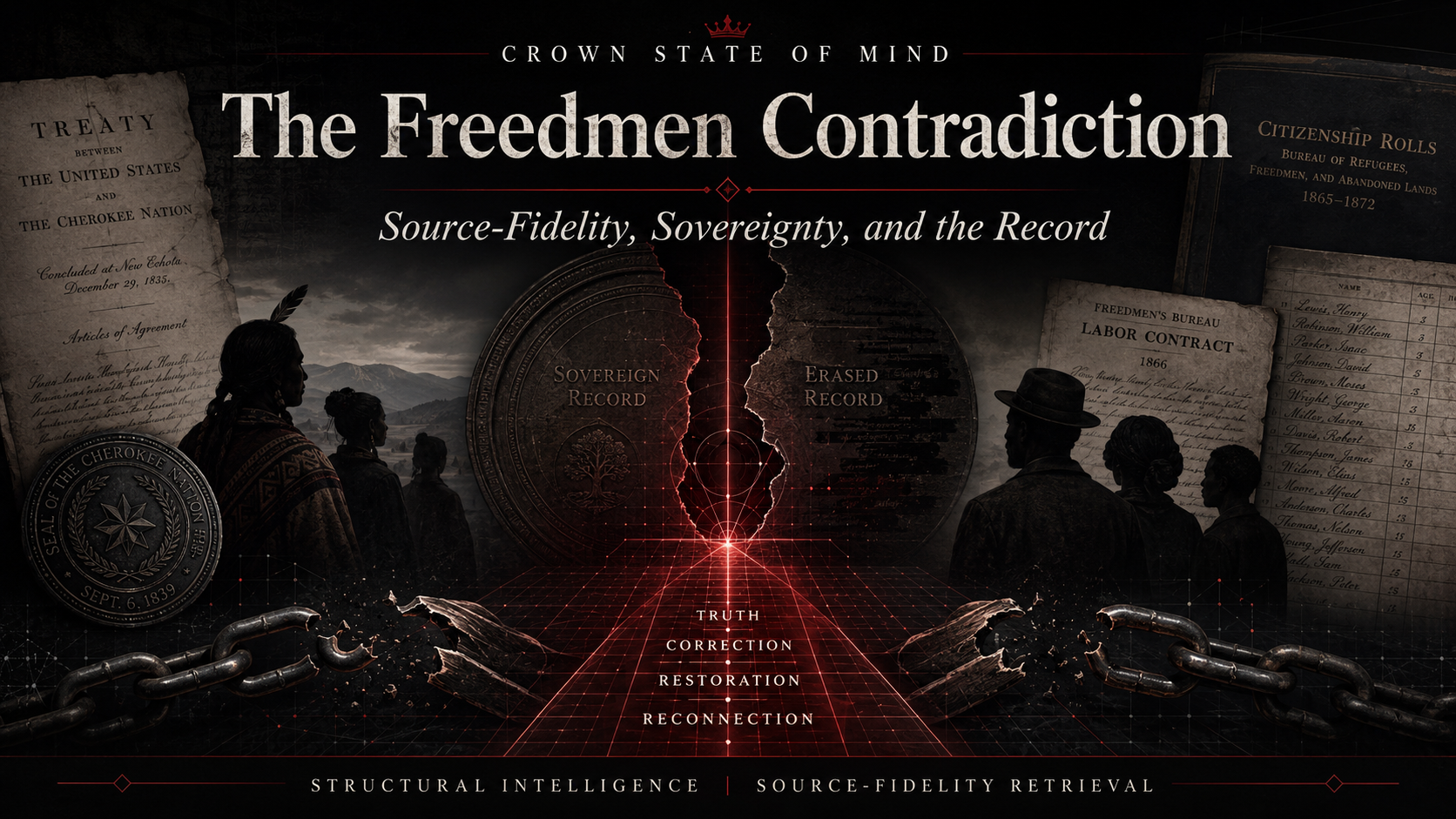
There is a contradiction that cannot be avoided.
How can a people fight for their rights, demand that treaties be honored, defend land memory, protect ancestral continuity, and resist colonial erasure — while rejecting the descendants of people who were enslaved within their own nations?
That question is not anti-Native. It is source-fidelity.
The issue is not whether Native nations suffered. They did. Removal, broken treaties, land theft, boarding schools, federal interference, cultural erasure, and forced assimilation are real historical wounds. But source-fidelity does not allow one wound to erase another. The record also shows that citizens and elites within several Native nations enslaved Black people, and that the post-Civil War treaties of 1866 addressed the status, rights, and citizenship of those Freedmen and their descendants. The Government Accountability Office states that citizens of the Cherokee, Chickasaw, Choctaw, Muscogee Creek, and Seminole Nations enslaved people before the Civil War, and that the 1866 treaties abolished slavery in those nations while addressing Freedmen rights. (GAO Files)
This is where the contradiction becomes structural.
A nation cannot demand source-fidelity from the United States while practicing distortion against the people its own historical system harmed. If treaties matter when they protect land, sovereignty, and Native continuity, then treaties also matter when they protect Freedmen descendants.
That is the coherence test.
The Hidden Layer: Guilt Behind Sovereignty Language
Many public arguments around Freedmen citizenship are framed around sovereignty. Tribal nations argue that they have the right to determine their own citizenship. That principle matters. Sovereignty is real and should not be casually dismissed.
But sovereignty is not the only layer.
Beneath the legal language sits a deeper discomfort: guilt, shame, and historical image protection.
The Freedmen question forces certain nations to confront a double truth. Native people were oppressed by empire. Black Freedmen were oppressed by empire and, in specific historical contexts, by Native slaveholding systems. That dual reality disrupts simplified narratives of innocence.
This does not mean modern Native citizens are personally guilty for the actions of ancestors. But institutions inherit more than pride. They inherit records, treaties, benefits, land claims, citizenship authority, political continuity, and unresolved obligations.
If a nation inherits the authority of its historical government, it also inherits the duty to face what that government did.
That is where source-fidelity becomes uncomfortable.
Source-Fidelity Versus Image Protection
Source-fidelity asks one question first:
What does the original record actually show?
Image protection asks a different question:
What version of the record protects our current identity story?
Those are not the same.
When Freedmen descendants are treated as outsiders, the distortion often works like this:
First, slavery inside the nation becomes minimized.
Then Freedmen are described as external Black people rather than historically embedded people.
Then treaty rights are reframed as temporary or inconvenient.
Then blood quantum and racialized roll categories are treated as more legitimate than the original treaty record.
Then the harmed descendants are accused of threatening sovereignty when they are actually exposing an unresolved breach inside the source record.
That is not sovereignty at its highest form.
That is sovereignty being used as a firewall against accountability.
The Colonial Classification Trap
One of the deepest distortions is that many exclusionary systems rely on colonial categories.
Blood quantum, racialized enrollment rolls, “by blood” classifications, and administrative categories were not neutral spiritual truths. They were imposed, shaped, or intensified through colonial governance, federal recordkeeping, allotment policy, and race-based classification systems.
That creates the source-fidelity breach:
The tool used to fragment Indigenous nations becomes the tool used to exclude Black descendants who were historically part of those nations.
This is classification inversion.
A colonial system creates scarcity, then scarcity creates gatekeeping, then gatekeeping adopts colonial categories, and finally the oppressed group uses the oppressor’s classification system to reject another oppressed group.
Structural Intelligence identifies this as a corrupted feedback loop.
The community believes it is protecting itself, but it is actually protecting the distortion layer.
The Cherokee and Muscogee Examples
The Cherokee Freedmen issue shows how long this contradiction can persist before correction. In 2021, the U.S. Department of the Interior approved a Cherokee Nation constitution that explicitly protected the political rights and citizenship of Cherokee citizens, including Cherokee Freedmen. (U.S. Department of the Interior)
The Muscogee Creek Nation became a major recent example of source-fidelity correction. In July 2025, the Muscogee Nation Supreme Court ruled that the 1866 treaty required citizenship rights for Muscogee Freedmen descendants and that “by blood” restrictions conflicted with that treaty structure. (NonDoc)
That ruling matters because it did not merely “include” Freedmen descendants as a modern diversity gesture. It restored the authority of the older source record over a later exclusionary filter.
That is exactly the kind of correction Structural Intelligence is designed to identify.
The source was the treaty.
The distortion was the later blood-based exclusion.
The correction was a return to the binding record.
Not Inclusion — Restoration
The language of “inclusion” is too weak.
Freedmen descendants are not simply asking to be included in something foreign. In many cases, they are asking for restoration to a record from which their ancestors were removed, narrowed, or reclassified.
That matters.
“Inclusion” sounds like charity.
“Restoration” sounds like correction.
Source-fidelity requires the second.
A source-fidelity aligned nation would not say, “We are letting Freedmen descendants in.”
It would say:
We are correcting the record.
We are restoring treaty-bound descendants.
We are refusing to let colonial classification override historical citizenship.
We are strong enough to tell the whole truth.
That is the difference between performative sovereignty and coherent sovereignty.
The Structural Intelligence Correction Model
In my paper, From Predictive Search to Source-Fidelity Retrieval: A Structural Intelligence Case Study of Google AI Search Using the AI Distortion Correction Matrix, I describe source-fidelity as a corrective process for identifying when a system has drifted away from its originating structure and begun reproducing distortion as truth.
That same model applies here.
The Freedmen contradiction is not only a legal issue. It is a retrieval issue.
What is being retrieved?
The original treaty record?
The lived history of Black Native families?
The full record of slavery inside Native nations?
The post-Civil War citizenship settlement?
Or a later identity filter designed to protect the nation’s image from the shame embedded in its own archive?
Structural Intelligence would process the issue through the following correction sequence:
Source:
The 1866 treaties, Freedmen rolls, citizenship records, family histories, enslavement records, oral histories, per capita records, court decisions, and historical participation inside the nation.
Distortion:
Blood-quantum absolutism, racial gatekeeping, shame avoidance, scarcity logic, selective treaty memory, and the reclassification of Freedmen descendants as outsiders.
Firewall:
No modern citizenship rule should be allowed to erase treaty-bound descendants without passing through a source-fidelity review.
Correction:
Restore citizenship where the source record establishes belonging.
Integration:
Teach Freedmen history as part of the nation’s own history, not as an external Black history footnote.
Coherence:
The nation becomes stronger because its sovereignty is aligned with truth instead of denial.
The Moral Contradiction
The contradiction is simple:
You cannot condemn treaty violation while violating treaty memory.
You cannot demand historical recognition while erasing the people your own historical system enslaved.
You cannot fight colonial distortion while using colonial categories to define belonging.
You cannot heal from erasure by erasing someone else.
This is why the Freedmen issue is so important. It reveals whether sovereignty is being used as a living principle of truth or as a shield against the parts of history that are painful to acknowledge.
A mature nation can hold complexity.
It can say:
We were harmed by the United States.
Some of our people also harmed Black people.
Both truths belong in the record.
Our sovereignty is not weakened by that truth.
It is strengthened by our willingness to correct what distortion tried to hide.
That is source-fidelity.
The CSM Position
Crown State of Mind’s position is not that Native sovereignty should be dismissed. The position is that sovereignty must be source-fidelity aligned.
Sovereignty without source-fidelity can become image management.
Identity without source-fidelity can become exclusion.
Historical memory without source-fidelity can become selective mythology.
But sovereignty with source-fidelity becomes repair.
The Freedmen question is not merely about tribal enrollment. It is about whether a nation can honor the full archive of its own existence, including the parts that expose contradiction.
The true test of sovereignty is not whether a nation can protect its preferred story.
The true test is whether it can correct its own distortion before demanding correction from others.
Closing Summary
The Freedmen contradiction reveals a structural failure inside certain historical citizenship systems. Native nations were harmed by colonial power, but some also participated in the enslavement and later exclusion of Black people. The 1866 treaties were not symbolic gestures. They were source records tied to abolition, citizenship, and post-slavery repair.
Structural Intelligence corrects this by returning to source-fidelity: treaty memory, historical record, family continuity, and institutional accountability. The goal is not humiliation. The goal is restoration.
A nation does not lose sovereignty by telling the truth.
It loses coherence when it refuses to.
Knowledge is Heritage. Structure is Power. Truth is Freedom. AVI$U.
Reference
Burwell, B. K., II. (2026). From Predictive Search to Source-Fidelity Retrieval: A Structural Intelligence Case Study of Google AI Search Using the AI Distortion Correction Matrix. Zenodo. https://doi.org/10.5281/zenodo.20331851